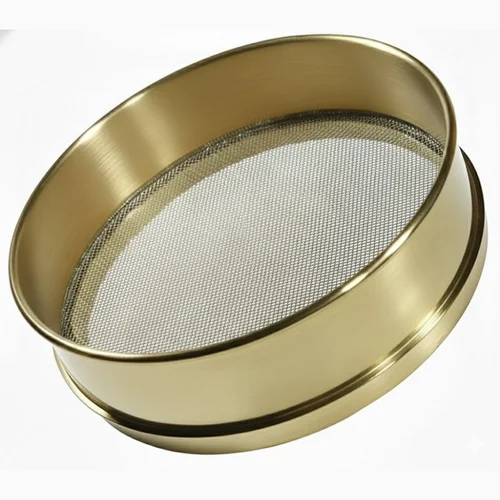
testing sieve is an essential laboratory instrument widely used in educational environments to help students understand particle size analysis, material classification, and quality control processes. This versatile tool is designed to separate and grade materials based on their granular size, making it highly valuable for science, engineering, geology, agriculture, and environmental studies. Constructed with precision and durability in mind, the sieve features a robust metal frame that supports a fine mesh screen, ensuring accuracy and consistency in experimental results. Its sturdy build allows it to withstand frequent use in classroom laboratories where repeated handling, cleaning, and sample testing are part of the learning routine. The mesh is manufactured to maintain uniform openings, enabling students to observe the separation of particles in a reliable and structured way, which is crucial for understanding soil composition, aggregate grading, and other material-based studies.
Description
Introduction to Testing Sieves Brass
Testing Sieves Brass are precision laboratory tools used to analyze the particle size distribution of granular materials such as sand, soil, gravel, and powders. Civil engineering laboratories, environmental science programs, and materials testing facilities widely use these sieves for accurate material classification.
The sieve consists of a circular brass frame fitted with a finely woven mesh that allows particles of specific sizes to pass through during testing. Moreover, the durable brass construction provides strength and corrosion resistance, ensuring long-term reliability in laboratory environments.
Educational institutions frequently use this equipment to help students understand particle distribution and material grading. Therefore, it plays an important role in practical training related to construction materials, soil science, and environmental studies.
Working Principle of Testing Sieves Brass
The sieve works on the principle of mechanical separation based on particle size. A sample material is placed on the sieve mesh and then shaken manually or with a sieve shaker.
During agitation, smaller particles pass through the mesh openings while larger particles remain on the surface. Consequently, the material separates into layers according to particle size.
This process helps researchers and students determine the size distribution of the sample. As a result, laboratories can analyze properties such as uniformity, particle shape, and material grading.
Applications of Testing Sieves Brass
Civil engineering laboratories commonly use these sieves for analyzing the size distribution of construction materials such as sand and aggregates. Engineers rely on this analysis to evaluate the suitability of materials used in concrete and road construction.
Environmental and agricultural science programs also use sieves to study soil texture and sediment classification. Moreover, researchers analyze soil granularity to understand water retention, erosion patterns, and nutrient availability.
In addition, industries such as mining, pharmaceuticals, and food processing use similar sieving methods to classify powders and granular materials.
Features
These laboratory sieves include several features that ensure accurate and reliable particle size analysis.
Firstly, the brass frame provides strong and corrosion-resistant support for the mesh. Secondly, the precision mesh ensures consistent and standardized results during testing.
Key features include:
- Durable brass frame construction
- Precision mesh for accurate particle separation
- Suitable for sand, soil, powders, and granular materials
- Compatible with manual shaking or sieve shakers
- Easy cleaning and minimal mesh clogging
These features make the sieve dependable for repeated laboratory testing.
Educational Importance
Practical material testing is essential in engineering and environmental education. Therefore, laboratories use these sieves to demonstrate particle size analysis and soil classification techniques.
Students gain hands-on experience in separating materials and analyzing particle distribution. Moreover, the visual separation of particles helps learners understand theoretical concepts related to material grading.
Consequently, this equipment helps students develop analytical skills and understand the importance of measurement accuracy in laboratory experiments. Educational institutions can also explore related laboratory kits here:
https://www.aseducationalkits.com/products-category/ncert-educational-kits/
Industrial Uses
Testing sieves are widely used in industries that require particle size control and material quality testing. Construction industries rely on sieves to evaluate aggregates used in concrete and road building.
Mining industries use sieves to classify minerals and crushed materials. Additionally, pharmaceutical and food processing industries use sieving methods to ensure uniform particle size in powders and granules.
Training equipment and technical education systems related to skill development can also be explored here:
https://interlabs.in/product-category/training-and-skill-development/
For additional laboratory glassware collections and scientific equipment references, visit:
https://www.iwaki-pyrex.com/products/
Conclusion
Testing Sieves Brass are essential laboratory tools used for particle size analysis and material classification. Their durable brass construction, precision mesh, and reliable performance make them suitable for engineering, environmental, and industrial testing.
Therefore, they remain an indispensable part of laboratories involved in materials analysis, soil testing, and scientific education.