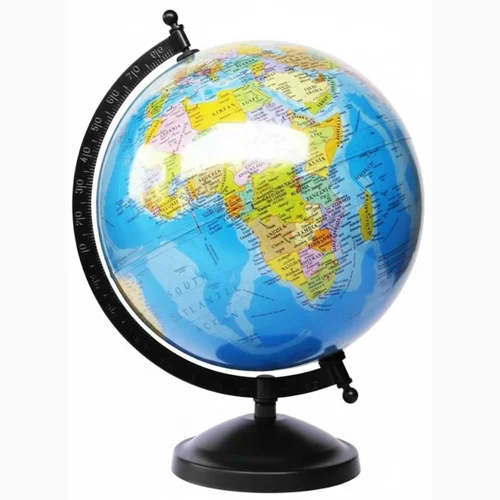
A globe is one of the most important educational tools used in classrooms to help students develop a strong understanding of the Earth’s geography, spatial relationships, and global concepts. Designed as a three-dimensional representation of the world, a globe provides a realistic and accurate model of the planet, allowing learners to visually explore continents, oceans, countries, mountain ranges, and other geographical features in their true proportions. Unlike flat maps, which distort size and shape due to their two-dimensional format, a globe captures the natural curvature of Earth and presents locations with enhanced precision.
Description
This makes it an indispensable learning aid for subjects such as geography, environmental science, history, and general knowledge. Students can rotate the sphere to view different regions and understand how the Earth’s rotation influences time zones, climate patterns, and day–night cycles, making lessons far more interactive and intuitive.
The globe is crafted with clarity and durability in mind, featuring a smooth spherical surface that displays clear boundaries, labels, and color-coded regions for easy identification. It typically sits on a sturdy base with a semi-meridian or full meridian frame, allowing it to tilt and rotate smoothly so students can examine any part of the world with ease. The high-quality printing ensures that even small countries, islands, and geographical markers are visible and easy to read, making it suitable for learners of various age groups. Whether used in primary classrooms or advanced academic settings, the globe promotes active engagement by encouraging students to touch, rotate, and explore, making the learning experience tactile as well as visual.
In educational environments, a globe plays a crucial role in helping students understand key concepts such as latitude, longitude, the equator, the poles, and hemispheres. By physically locating these elements on the globe, learners gain a concrete understanding of global positioning and navigation. This makes it easier for them to interpret maps, understand Earth’s axis, and relate geographical information to real-world contexts. A globe also supports lessons related to climate zones, ocean currents, and population distribution, helping students make sense of global patterns and connections. Many modern globes include updated political boundaries and geographical data, ensuring that learners receive accurate and relevant information during their studies.
Beyond academic use, a globe encourages curiosity about the world, cultures, and global diversity. It serves as a visual reminder of the interconnectedness of nations and the importance of understanding global perspectives. Students can explore regions they have heard about in news, literature, or science lessons, making their learning broader and more meaningful. The globe also enhances classroom décor by adding an element of sophistication and relevance, symbolizing the universal quest for knowledge and exploration.
Built to withstand regular use, the globe is designed for long-lasting performance in schools, colleges, libraries, and educational training centers. Its stable base and easy rotation make it safe and convenient for students to handle. As a timeless educational resource, the globe continues to be an essential tool for teaching world geography and fostering global awareness, offering a hands-on and accurate representation of the planet that enhances both learning outcomes and classroom engagement.