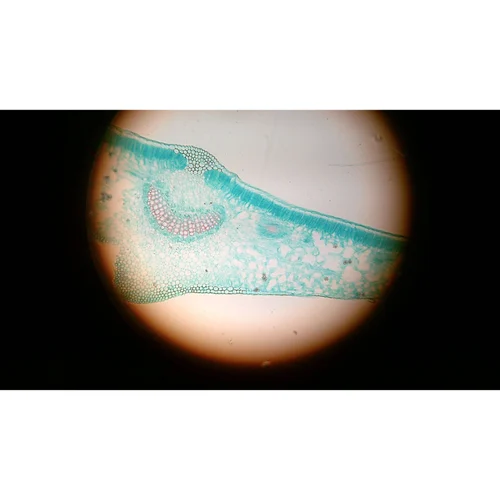
The permanent slide of stomata of dicot plants is a precisely prepared botanical specimen designed to showcase the microscopic structure and arrangement of stomata in dicotyledonous plant species. This slide offers a clear and detailed view of one of the most essential structures in plant physiology, enabling learners and researchers to study the unique features of dicot stomata with accuracy. Stomata are small openings found mainly on the leaf epidermis, responsible for regulating gas exchange and controlling water loss through transpiration. In dicot plants, these structures exhibit a characteristic pattern and distribution that distinguish them from those of monocots, making this slide a valuable tool for comparative botanical studies. By observing this specimen under a microscope, viewers can easily identify guard cells, subsidiary cells, and the stomatal pore, as well as understand their role in plant metabolic processes.
Description
This permanent slide has been prepared with precision to ensure that all essential microscopic details are preserved. The sample is taken from the epidermis of a dicot leaf, often from commonly studied species in botanical education, to provide a representative view of dicot stomatal structure. Through careful staining, the contrast between cell walls, guard cells, and surrounding epidermal cells is enhanced, making the microscopic examination more accessible and educational. The high clarity of the slide allows learners to observe the bean-shaped guard cells, which are a distinct feature of dicot stomata, and to study how their shape and arrangement facilitate the opening and closing of the stomatal pore. This is crucial for understanding how plants balance carbon dioxide intake for photosynthesis with water conservation.
In educational settings, this permanent slide is an excellent resource for teaching topics in plant anatomy, physiology, and taxonomy. It helps students comprehend how the structure of stomata supports their function in regulating transpiration, enabling plants to adapt to varying environmental conditions. The detailed view also aids in explaining the mechanism of stomatal movement, including the role of turgor pressure in guard cells and the influence of light, humidity, and internal CO₂ concentration. The specimen provides an ideal visual aid for laboratory exercises, examinations, and academic projects, helping students link theoretical concepts to real microscopic evidence.
The slide is mounted on high-quality glass with a protective cover slip, ensuring long-term durability and resistance to damage from repeated handling. The specimen is permanently sealed, preventing deterioration and preserving the accuracy of its microscopic features for years of use. It is compatible with standard compound microscopes as well as advanced digital imaging systems, making it suitable for both traditional and modern teaching environments. The detailed preservation of stomatal structures in this slide ensures that learners at different academic levels, from high school biology to advanced botanical research, can gain an in-depth understanding of dicot plant anatomy.
Beyond classroom use, this slide is a valuable tool for research laboratories focusing on plant physiology, environmental biology, or crop science. Since stomata are key indicators of plant health and adaptability, studying their form and function is essential in fields like agriculture, ecology, and climate change research. The permanent slide of stomata of dicot plants serves as a reliable and precise reference specimen, enabling accurate observation, analysis, and comparison for both educational and professional purposes, making it an indispensable resource in the study of plant biology.