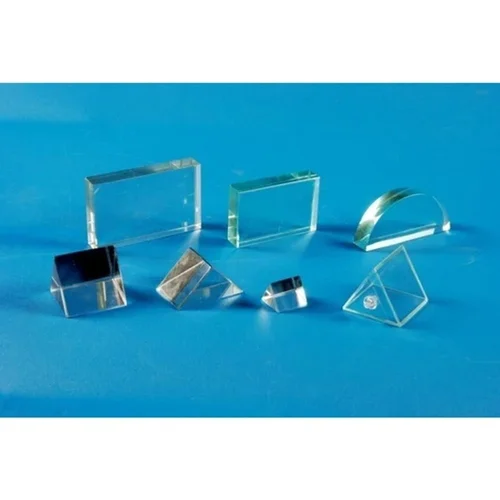
Glass prisms split white light into a spectrum (rainbow) via dispersion due to angled surfaces, used in spectroscopes, periscopes, and telescopes, while glass slabs, with parallel sides, only cause a lateral shift, demonstrating refraction and displacement, making them great for basic science experiments showing light bending without color separation. Prisms change light direction significantly and separate colors (dispersion); slabs shift light sideways but keep it parallel (lateral displacement).
Description
Glass prisms split white light into a spectrum (rainbow) via dispersion due to angled surfaces, used in spectroscopes, periscopes, and telescopes, while glass slabs, with parallel sides, only cause a lateral shift, demonstrating refraction and displacement, making them great for basic science experiments showing light bending without color separation. Prisms change light direction significantly and separate colors (dispersion); slabs shift light sideways but keep it parallel (lateral displacement).